+91-93261 15588 hypnotherapy28@gmail.com Book a Consultation

Hypnotherapy Pvt Ltd  ·  Mumbai  ·  Est. practice of 15+ years

About the practitioner

Experience, understanding and a personalised approach to hypnotherapy.

Vibha Jain has practised hypnotherapy in Mumbai for more than fifteen years. What has stayed constant across those years is not a technique but a habit of mind: listen first, assume nothing, and let the person in front of you set the pace.

15+ Years of professional hypnotherapy practice
2,400+ Individual and group sessions conducted
Portrait of Vibha Jain, professional hypnotherapist and founder of Hypnotherapy Pvt Ltd in Mumbai

Professional introduction

Fifteen years of sitting with people who wanted something to change

Vibha Jain leads the hypnotherapy practice at Hypnotherapy Pvt Ltd, working with individuals across Mumbai and the wider Mumbai Metropolitan Region. Over more than fifteen years and upwards of 2,400 sessions, she has worked with students facing examinations, professionals under sustained pressure, homemakers carrying invisible loads, entrepreneurs whose confidence had quietly eroded, and people who simply wanted to understand themselves more clearly.

The variety matters. It is the reason her practice resists a single template. A technique that helps one person settle within minutes can leave another feeling self-conscious and stuck; an approach that suits a person comfortable with imagery may need complete reworking for someone more analytical. Fifteen years of that variety teaches something a manual cannot: how to read the person in front of you and adjust.

Sessions are conducted one-to-one in a private, confidential setting, and they begin with conversation rather than with hypnosis. Before any therapeutic technique is considered, there is a discussion about what is actually happening, what has already been tried, what daily life looks like, and what a realistic improvement would mean to you. That conversation also decides something important — whether hypnotherapy is a sensible fit for your situation at all.

Alongside individual work, Vibha has guided group sessions and public demonstrations introducing people to what hypnotherapy actually involves. These sessions tend to do a great deal of quiet myth-correction: most participants arrive with expectations shaped by films and stage shows, and leave with a far more accurate — and considerably less dramatic — understanding of a focused, collaborative therapeutic process.

The professional journey

How a practice matures

The stages below describe how the work itself has developed rather than a chronology of dates. It is the honest shape of a long practice: enthusiasm, then discipline, then judgement, then restraint.

Stage one

Learning the craft

Every practitioner begins with method — inductions, deepening, suggestion structures, the mechanics of guiding attention. This stage is about competence: doing the thing correctly, in the right order, with a client who is comfortable. It is necessary groundwork, and it is also the stage at which a practitioner is most tempted to believe the technique is doing the work.

Stage two

Learning the person

With volume comes the realisation that the same well-executed session lands entirely differently across two people. One settles immediately; another spends the whole session monitoring themselves. This is where listening becomes the primary skill — noticing what someone avoids saying, what they minimise, which words they use for their own difficulty, and what they are quietly afraid the answer might be.

It is also where a practitioner learns to ask better questions before offering anything at all.

Stage three

Working with groups and dispelling myths

Guiding group sessions and demonstrations brought a different challenge: an audience arriving with expectations built almost entirely from entertainment. Explaining hypnosis clearly to a room of sceptics — and then letting them experience something considerably calmer than they had imagined — sharpens the ability to describe the work in plain language, without mystique and without overselling.

Stage four

Knowing when not to

The most useful thing experience adds is restraint. Recognising when a concern calls for medical or psychological care rather than hypnotherapy; when someone is not ready and would be better served by waiting; when a session should slow down or stop; and when the honest answer to "can you fix this?" is "not on my own, and not in the way you are hoping."

Saying so costs a session. Not saying so costs a person's trust — and possibly a great deal more.

Today

A settled, unhurried practice

The present-day practice is deliberately unhurried. Fewer assumptions, longer initial conversations, plainer explanations, and goals defined clearly enough that both of us can tell whether anything is actually changing. Consultations are available in person in Mumbai and online for those who find that easier to arrange.

Philosophy & approach

Seven principles that shape every session

I

Individual understanding

Two people describing "anxiety" are rarely describing the same experience. Before any approach is chosen, the work is to understand your version of it — where it appears, what precedes it, what it costs you, and what you have learned to do around it.

II

Listening before technique

Most sessions contain more conversation than people expect. Listening is not a warm-up to the therapeutic work; it is a substantial part of it, and it is what makes the rest accurate rather than generic.

III

Personalisation

Language, imagery, pacing and depth are adjusted to the individual. Someone who thinks in pictures and someone who thinks in arguments need different sessions, even when they arrive with the same stated goal.

IV

Respect and dignity

No one is asked to perform, to prove they are "a good subject", or to disclose more than they wish to. Reluctance is treated as information worth understanding, not resistance to be overcome.

V

Confidentiality

What is discussed in a session stays in the session. This is a professional obligation and a practical one: people cannot work honestly on something they are worried might be repeated elsewhere.

VI

Realistic expectations

No guarantees, no promised timelines, no claims of permanent cure. Where progress is likely to be gradual, that is said at the outset — and where hypnotherapy is unlikely to be the right tool, that is said too.

VII

Collaborative goal-setting

Goals are agreed rather than assigned. You decide what is worth working towards; the practitioner's contribution is to help make that goal specific enough to be workable and honest enough to be achievable.

What clients can expect

From first message to follow-up

Knowing the shape of the process removes a surprising amount of first-session nervousness. Here is what working with a hypnotherapy practitioner generally involves.

01

An initial conversation

A discussion — not a session — about what brings you here and what you would like to be different. You are welcome to ask anything, including how the process works, what it will not do, and why a particular approach is being suggested.

02

Understanding your goals

Turning a general wish into something workable. "More confidence" becomes specific: in which rooms, with which people, at which moment does it currently fall away — and what would a realistic improvement look like from the outside?

03

An honest suitability assessment

A frank view of whether hypnotherapy is appropriate for what you have described, whether it should sit alongside medical or psychological care you are already receiving, and whether now is the right time to begin.

04

A personalised plan

An approach shaped for you rather than a fixed package: which techniques, in what order, at what depth, and how we will know whether it is helping. Plans are revisited rather than rigidly followed.

05

Guided sessions

The therapeutic work itself, conducted at a pace you can stay comfortable with. You remain aware, you can speak, and you can pause or end the session at any point without explanation.

06

Reflection and follow-up

Time afterwards to discuss what the experience was like and what is worth noticing in the days that follow. Early change is usually small and easy to miss, which is exactly why it is worth naming out loud.

In practice

Individual sessions, group work and demonstrations

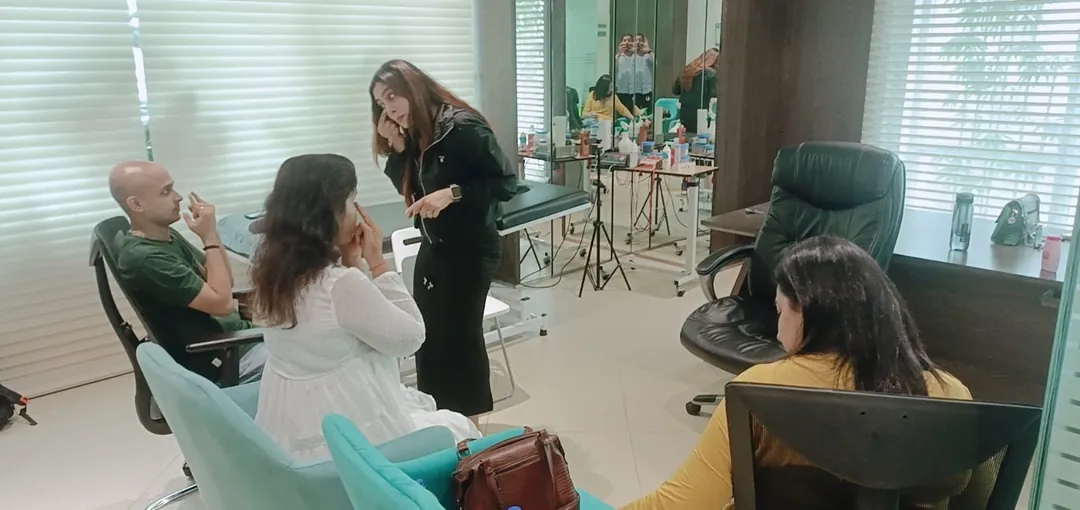
Moments from ongoing practice across Mumbai — one-to-one work, guided group sessions and introductory demonstrations for people encountering hypnotherapy for the first time.

Vibha Jain leading a group hypnotherapy session with participants seated in a circle around her
Guiding a group session in Mumbai
The words About Us spelled out in wooden blocks, introducing the practice
About the practice
Vibha Jain working with clients in a calm, professional practice setting
One-to-one work in a professional setting

The next step

Start with a conversation, not a commitment.

An initial discussion is exactly that — a chance to describe your situation, ask whatever you need to, and hear an honest view on whether hypnotherapy is likely to help.